The HoneyFil panel prints eight ingredients, each on a line of its own. This page walks them in panel order: what the ingredient is, where it is grown or made, and why a men’s daily formula would carry it at all.
Quantities are the one thing you will not find here. No itemised breakdown has been published by the manufacturer, and the Supplement Facts panel on your own bottle is the authority on amounts. Everything written below describes an ingredient, not a claim about what the finished gummy will do.
Vitamin B3 (Niacin)
Turned into NAD and NADP, the two coenzymes that move electrons through every reaction that releases energy from what you eat.
Niacin has one of the clearest jobs on any supplement panel. The body turns it into NAD and NADP, and those two coenzymes shuttle electrons through the reactions that pull energy out of carbohydrate, fat and protein. Strip them out and the machinery that powers a cell simply stops.
Because it dissolves in water, none of it is banked. Whatever is not used leaves, and tomorrow's supply has to arrive tomorrow. That property is the whole argument for putting it on a once-daily panel rather than an occasional one, and it is why HoneyFil lists it first.
Zinc (as Zinc Oxide)
A structural metal for several hundred enzymes. Held in almost no reserve, spent daily, and replaced daily or not at all.
Few trace minerals reach as far. Zinc sits at the structural centre of several hundred enzymes, holding them in the shape that lets them work, which puts it simultaneously inside protein synthesis, cell division, immune signalling and the maintenance of normal testosterone levels.
Accumulation is the one thing it will not do. The body keeps almost nothing in reserve and spends it continuously, so supply has to keep pace rather than catch up afterwards. Men's formulas treat it as effectively compulsory for that reason. HoneyFil lists it as zinc oxide, a standard supplement form.
L-Citrulline
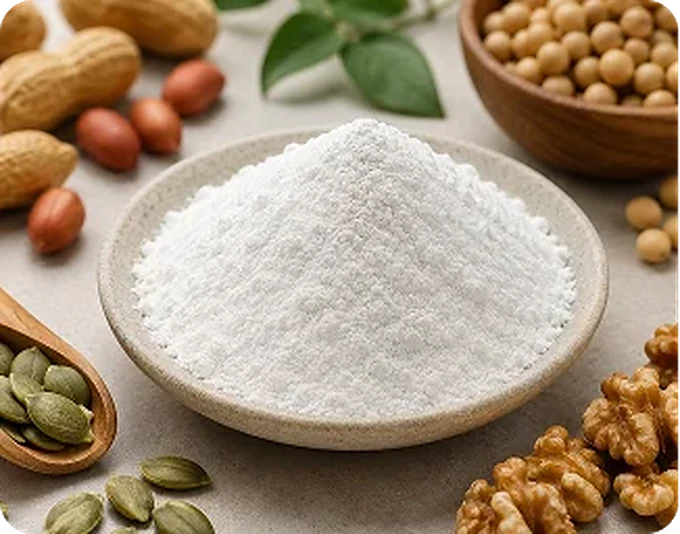
Reaches circulation intact where arginine does not, then becomes arginine downstream. That detour is the whole reason it is used.
The interesting thing about L-citrulline is that the body does not use it as citrulline. Arginine is the amino acid that feeds nitric oxide production and relaxes the smooth muscle lining a blood vessel — but arginine swallowed as arginine is largely broken down in the gut before it reaches circulation.
Citrulline takes a different road. It survives the gut, reaches the kidney and is converted to arginine there, which means it raises circulating arginine more dependably than arginine itself manages. That detour is the entire reason circulation formulas reach for it, and why it sits beside pine bark on the HoneyFil panel rather than standing alone.
L-Carnitine
The doorman of the mitochondrion for long-chain fat. Nothing crosses that membrane without it, and nothing burns before it crosses.
L-carnitine is transport, not fuel. Long-chain fatty acids cannot cross the inner mitochondrial membrane unassisted; carnitine binds them, carries them over and lets go on the far side, where beta oxidation can finally start. Without the shuttle the fat sits outside the furnace, unburned.
The body synthesises some of its own from lysine and methionine, and red meat supplies more. Its place in a men's daily formula points at the same region of metabolism as niacin: converting stored fuel into something the body can spend. HoneyFil names it on its own line rather than folding it into a blend.
Pine Bark Extract
Maritime pine bark, standardised on proanthocyanidins so that one batch answers for the next. A vascular-formula staple for decades.
Bark from Pinus pinaster, the French maritime pine, is unusually dense in proanthocyanidins — a polyphenol family that also turns up in grape seed and cocoa. Commercial extracts are standardised on that fraction, which is what allows one batch to be compared against another instead of taken on faith.
Attention to the group has always concentrated on the vascular system and on antioxidant behaviour, which explains why it appears in circulation-minded formulas rather than in general multivitamins. Inside HoneyFil it works the same territory as L-citrulline, approached from a plant instead of an amino acid.
Maca Root Extract
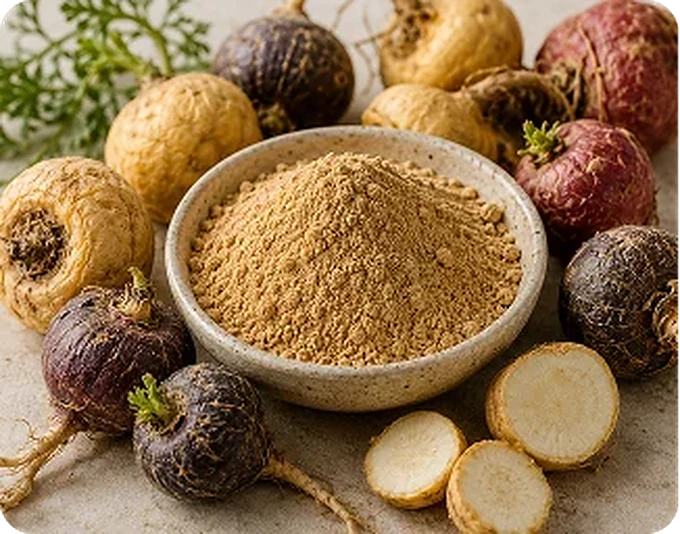
A high-altitude Andean crop, grown where frost and thin air stop almost everything else, and eaten as food there for centuries.
Maca is a brassica — a relative of the radish — farmed on the Peruvian altiplano at four thousand metres and higher, on ground where frost, wind and thin air defeat almost every other crop. It has been food there for centuries, dried and stored to carry households through winter, long before anyone thought to concentrate it into an extract.
Its Andean reputation has always been about endurance under hard conditions, and that reputation is what carried it into western men's formulas. Tuber colour varies widely, from pale cream through to something close to black. HoneyFil uses a root extract.
Grape Skin Extract
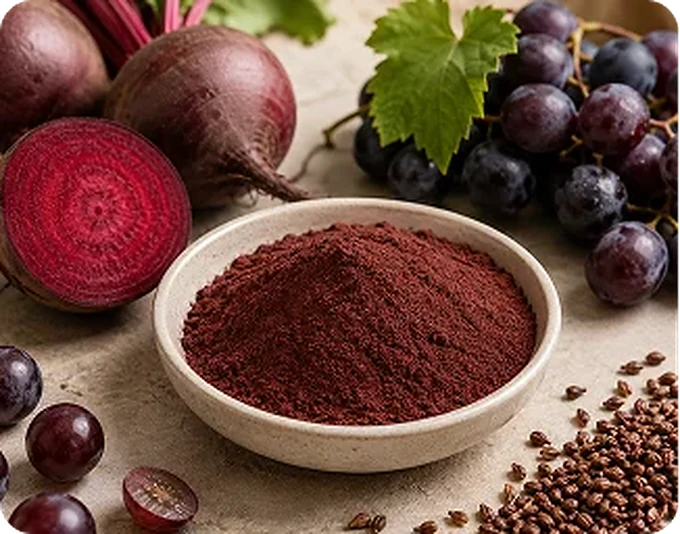
The polyphenols sit in the skin, which is the fraction a winery presses and throws away. This extract takes that fraction.
Grape skin is the part a winery presses and throws away, and it is also where the fruit keeps most of its polyphenols — the anthocyanins responsible for the colour of a red grape, plus resveratrol and a spread of related compounds. The juice carries comparatively little.
Extracting from the skin rather than the whole fruit is therefore a choice about concentration, not economy. On the HoneyFil panel it stands beside pine bark on the polyphenol side of the formula, drawn from a different plant and a different part of it.
Saffron Stigmas Extract
Three hand-picked threads per crocus flower. Gram for gram, the most expensive thing named anywhere on this panel.
Saffron is the dried stigma of Crocus sativus. Every flower yields exactly three, each lifted by hand inside a short autumn window, which is the whole reason it has been the most expensive agricultural product on earth for most of recorded history.
Its principal compounds — crocin, safranal and picrocrocin — account for the colour, the aroma and the bitterness in turn. Supplement work uses it at small inclusions for precisely that reason. Nothing else named anywhere on the HoneyFil panel comes close to it in cost per gram.
What this page deliberately omits
Amounts, for the reason set out above. Any comparison against another product, because this is the official information page for one formula rather than a ranking. And any clinical claim attached to HoneyFil itself — the reference material linked from the homepage concerns single ingredients studied alone, which is a different subject from a finished gummy.
The serving is written out on the serving page, the manufacturing standard on the quality page, and the three sizes on the packages page.